Wednesday, 2 May 2012
Italian Traveller: A magnificent hotel, pity about the restaurant!
Italian Traveller: A magnificent hotel, pity about the restaurant!: Part of the University of Bari Sunday February 27 in 2000 is a date forever etched into my memory. I was back in Puglia and for the ne...

A magnificent hotel, pity about the restaurant!
 |
| Part of the University of Bari |
Sunday February
27 in 2000 is a date forever etched into my memory. I was back in Puglia and
for the next seven days my life was one comedy act after another – even though
I didn’t think so at the time.
We arrived
at the Hotel Palace in Bari. We had caught a domestic flight from Rome and the
ubiquitous mini bus had picked us up. We all checked in and found we were in
one of the better hotels in Bari, the rooms were quite palatial compared to
other hotels we had stayed in.
 |
| The buildings are absolutely amazing |
We went back
to the hotel and got changed for dinner. Oh what fun awaited us as we were
lambs going to the slaughter!
 |
| Piazza Ferrarese |
 |
| A restaurant bordering the piazza |
The
restaurant was at the top of the hotel and we got out of the elevator to a
large foyer. There was a room to one side made up for about a dozen people and
we thought maybe that was for us. There were seven journalists, Livia our
guide, twin sisters from the tourism board and the mayor of Bari had promised
to dine with us - for a scruffy bunch of journos, we felt very important.
We soon
found out that we were not seated in this nicely decorated room when we were
shooed out by an overly enthusiastic waiter who kept yelling at us to
leave. Those of us who understood
Italian left immediately but the others didn’t understand what was going on and
this infuriated the waiter whose pitch got even louder (if you speak louder they
will understand). We had to go back and herd the remaining people out before
the guy had apoplexy.
While we
were wandering around like lost sheep Livia arrived and following close on her
heels the mayor. He spoke to Livia and then shook hands with us all and
basically said or inferred that an important person had arrived from Argentina
and we were no longer important enough for him and he would be dining with this
other person. We were very surprised, not that he wouldn’t dine with us – that
we understood – but it was what he said, very, very odd.
At this
stage we were all laughing at what had happened and with Livia leading the way
walked into the restaurant. There we were introduced the two ladies from the
tourism board. Although they were twins, they were not identical so it was
quite easy to tell them apart. They sat next to one another and were very
friendly.
We were
seated and then the menu came out, joy of joys, that night they were having a
special degustation of donkey meat. We declined and asked for the normal menus
to the utter disgust of the Maitre D. We chose our meals along with Frank, the
Dutchman, who went for the degustation. We then saw the wine menu and ordered
the wine, specific products that we were all keen to try.
We sat
talking until the meals came out, it was an extremely long conversation.
Finally they started coming, unfortunately not all of them and in the wrong
order. The entrees and mains came out together. Some people got an entree, some
people got a main and one person got both at the one time. Some people got
entrees they had ordered and some people got completely different meals. One of
the waiters was on his mobile phone and just plonked the plate down and walked
away so he could finish his conversation.
We tried to
call the waiters back but they were successfully ignoring us so we looked for
the Maitre D. We saw him on the other side of the room with a mobile phone fixed
to each ear. We thought we had entered the filming of some comedy TV show like
Candid Camera. It was totally crazy. The Maitre D finally put down one phone and
came over. By the time he had got to our table he had finished his conversation
and said could he help.
He said the
entrees were very similar to what we had ordered an the kitchen must have
substituted them for some reason and he was sure we would enjoy them. Franks
first course of his degustation arrived at this point and he started eating. We
decide to keep the entrees because it was less trouble and we were hungry by
this stage. However, the mains had to go back and entrees serve to those
people.
Frank’s next
course came out and he kept on eating.
We asked
where our wine was and a bottle came out and was poured, then the bottle
disappeared again. We were suspicious
and asked for the bottle. It was returned and it turned out not to be the wine
we had ordered. Once again the ‘kitchen’ had substituted the wine thinking that
we wouldn’t notice – they picked the wrong crowd, we knew our wines and we had
expected a good wine and we got a terrible wine.
Franks next
course came and he continue eating.
By this stage
the guys were getting a little touchy, it was no longer fun. Bill, a New Yorker
with a short fuse decided he’d had enough and got up and left. He said he had
seen a pizzeria near the hotel and if anybody felt like it they could join him.
Franks continued
his Donkey degustation without comment.
By this time
Bill had disappeared, Aaron was next to follow. Michael then left and Jim joined
him. Livia got up and left Frank, the twin sisters from the tourist board and
me.
 |
| The seafront in Bari |
Frank continued
to munch away.
I finally
said my apologies and left. Frank kept on eating.
Next: I get left behind
Tuesday, 1 May 2012
Italian Traveller: A mass of Marinas - Part 2
Italian Traveller: A mass of Marinas - Part 2: As we travelled further into the Abruzzo countryside we enjoyed the ever-changing scenery, the limestone hills, the hilltop towns and th...
A mass of Marinas - Part 2

As we travelled further into the Abruzzo countryside we enjoyed the ever-changing scenery, the limestone hills, the hilltop towns and the vast area of vineyards along the eastern side of the region.
Our first stop was at the Hotel Villa Majella, a gorgeous four star hotel with views all the way to the Gran Sasso (Big Rock) which appeared quite close it was so large. The Gran Sasso is the highest mountain in the region and it was covered all the way down into the foothills with snow. It was amazing to see the snow on the mountains and then the green of the countryside. The view went on forever.

 The hotel was in the town of Guardiagrele in the province of Chieti. It had recently been snowing and it was bitterly cold. After sitting on the bus for more than two hours we wanted to stretch our legs so those of us brave enough to take on the cold weather walked from one end of the town to the other. This took all of about ten minutes. Most of the buildings were quite old but there were some modernish (1950s) apartment blocks. I can’t remember much about the town except the steep drop down from the road into a valley, this allowed great views of the area. The town had a population of around 10,000 and took its name from the watchtower - Guardia. We were lucky to have a hotel with such a high standard in the area which was it seemed entirely rural.
After our arrival and before dinner we fitted in a visit to Azienda Agricola Santoleri owned by Umani Ronchi in Marche. It was their first foray into Abruzzo Part and they had only just taken over. The manager had set out a ‘few’ pastries for us to try with the wines - in other words in typical Italian fashion the table was loaded. As I said in the previous post, I think we must have been pigs in our last lifetime as we set about demolishing the plates of food but even we could not finish them. I would give you all my tasting notes on the wines but there really isn’t any point because the wines would be long gone by now.
.jpg)


.jpg)


Our return to the hotel saw the evening closing in and the weather turn nasty. After our magnificent evening meal (yes, we were ready to eat again!) we all went to our beds very satisfied and looking forward to the next day. It was one of the best night's sleep I have ever had in Italy - in the countryside with no traffic and pouring with rain and a terrific amount of food in our stomachs .
The next morning saw a very quiet group turn up for breakfast. The rain had cleared overnight and the morning was fresh, some of us had even got up a little early and gone for a walk to clear our heads. The sun was shining and the air was so crisp. I managed to take some photos before we left to go to Fattoria Bruno Nicodemi Dei Colli Venia in the winemaking zone of Teramo or Colline Teramane.
Bruno Nicodemi is now known for making superb Montepulciano d’Abruzzo, a wine often discounted by wine experts - the grape not the brand - but I feel is one of Italy’s best products. Montepulciano is a flavourful red wine that can be enjoyed with a simple pizza, pasta or roasted meats. It is a success story as it is one of the few wines made in Italy where you can’t make a mistake, it’s generally good stuff. Of course there will always be badly made stuff, made with a price in mind but you can still buy Montepulciano d’Abruzzo at a reasonable price.
Montepulciano has little to do with the town of the same name in Tuscany. The grape has been grown in Abruzzo for centuries and it is related to Sangiovese. It is thought that originally someone from Tuscany brought the vine with them to plant in Abruzzo and they may have come from the town of Montepulciano. However, over the centuries the grape has changed finding a new ‘terroir’ and its flavour profile has changed along with it. It is a little more full-bodied than sangiovese, a little less acidic and the colour is richer as well. I think that is why it has done so well in Australia.
Arriving at Bruno Nicodemi we drove through a dramatic path of trees which teased us with glipses of the winery the closer we got.The mag The trimmed pines partnered by olive trees were well looked after and the driveway was more reminiscent of Tuscany rather than Abruzzo. They guided us all the way past the vineyards and a small lake until we reached the end where the whole family came out to meet us.

 The winery is famous for its Trebbiano ‘Bacco’ which contains 15% Chardonnay. A lot of Trebbiano is grown in Abruzzo and most of it is very average wine but Bruno Nicodemi seems to have worked out just exactly what the wine needs. With good acidity and a floral nose with good fruit, it is very enjoyable. It has a persistent green apple finish which goes on and on - pity the wine isn’t available in Australia.They also make a beautiful Cerasuolo Montepulciano d’Abruzzo. This soft rose wine has a subtle flavour that is perfect for in-between seasons and summer dining.
We left Bruno Nicodemi for Illuminati, another family winery where the family came out to meet us. Illuminati is sold in Australia exclusively through Woolworth’s Dan Murphy stores and selected stores under their other brands BWS and Woolworth’s Liquor. The wines are very good value for money and my personal favourite is Ripparosso, an excellent easy drinking wine made from Montepulciano - the name kind of grabs me - its a ripper rosso!
We were staying for dinner at the winery and so we spent a great deal of time there which was very good for me. When they came out to Australia a few years ago I was a special guest at a lunch for some journalists. The father Dino remembered me and asked that I attend and keep him company. It was wonderful even after all that time.
The property is in Contraguerra and covers 80 hectares with 75 planted with vines. The panoramic views were exceptional and we couldn’t have felt more at home because the family were so nice. This was one visit that I will remember for a long time.

But getting back to Orlando Contucci, our visit turned out to be very awkward. Marina Orlando Contucci (yes, another Marina) was very abrasive with us. I don’t know whether she was nervous or it was just her manner. She talked about her winery and the history of the company and then she said to us she had lots of importers around the world and then proceeded to list them. When she came to Australia she named Gavagna Brothers as her importer which was news to me, I knew the Gavagna portfolio inside out and in fact, knew all the owners and sales managers of the wineries as well due to my frequent trips with both Gavagna men and on my own.
When I asked when had she dealt with Gavagna Brothers - it might have been before my time - she said she was exporting at that time. I said politely that she must have the name wrong, it must be another importer but she was adamant. I dropped the matter but when I got home I found she had sent some samples to Gavagna Brothers which had been rejected. It seemed she was right, she had exported 6 whole bottles!
Her property was a great deal larger than Illuminati, it was 850 hectares and her claim to fame was interesting: her father Corrado Orlando Contucci established the first Italian Embassy in the USA after WWII.
With our last day coming quickly we finally had a free night so what did we do - we went out and tried some more wine!
We had an 8.30 start on our last day. It was a Saturday and we had three wineries to go to. Casa Vinicola Roxan Soc. Coop. A.r.l., Az Agr Passetti and Az Agr Masciarelli. Of the three, I can only remember Roxan and Masciarelli, I have no notes on Passetti which must mean something.


Our visit to Roxan was surprising as they had decided to host us at the home of one of the co-op members. It was a magnificent house belonging to a barone (baron) and his wife. The rooms were very opulent and the elderly couple were extremely friendly although slightly confused about what was going on. It was a thoroughly enjoyable visit.
By the time we got to Masciarelli it was getting dark so we had a quick look in the cantina (wine cellars) and then we went into the house for dinner where we met his wife Marina - Marina Cvetic. It seemed we could not escape the name.
The wines of Masciarelli were excellent and for quite some time afterward I tried to interest a number of importers to no avail. They still remain without an importer but if you go to Italy or anywhere else where you seem the name, they are worth trying. Gianni Mascerelli passed away several years ago, he was a still a relatively young man (about 45) and his wife now runs the wine business.
Sunday arrived and most people left for Rome, I on the other hand being a glutton for punishment went to to meet several other journalists arriving in Bari where we had a really entertaining trip which involved eating donkey, the bus leaving without me and a strange castle in the countryside. This is where things went from bad to worse!

Next: Unforgetable Puglia - again!
Friday, 27 April 2012
To Abruzzo with love
 Travelling on a mini bus complete with a mink coat, my friend Marina decided to join us on our visit to Abruzzo. She figured as she had organised the trip she would accompany us. Looking glamorous in her fur (still common in Italy) she looked slightly incongruous, obviously not one of the group as we all looked very casual and crumpled in our jeans and jackets.
We arrived at our first winery (which I won’t name as it will embarrass them) and were welcomed by our guide, the director of IRMUS, an agricultural department of the local government. ‘Lino’ was obviously a ‘ladies man’ and gravitated immediately to Marina, who I must admit looked fabulous. He took her by the arm and spoke to her as if she was the only person in the world. This was quite remarkable considering he was supposed to be guiding us through the company’s winery and products. The guys were getting fed up while my friend Patricia (who lives in Italy) and myself were laughing at the obviousness of his attention. Marina was terribly embarrassed and tried to evade his attentions.
As it turned out, he didn’t really know a lot about wine and said a lot of stupid things that put everyone offside, things like the winery’s spumante was better than the finest quality Champagne when we as a group couldn’t even finish it. There was only one wine that was universally liked, an inexpensive Novello.
We finished our tour of the winery and thought we would get rid of Lino here but no, he accompanied us back all the way to the agriturismo where we were staying the night. I must say we all behaved ourselves very well and waited until he finally left before we all had a good laugh.
 |
| On te top of the hill, a farmer's cottage for inclement weather |
It was late autumn and getting very cold so the next morning we all rugged up for our next foray into the wilds of Abruzzo. Again I will not name the winery as I wouldn’t want to give them bad publicity even though they deserve it.
We found Colle S after a long drive on the highway which travelled over the water – half road half bridge. When we finally arrived we saw a winery which had seen better days but still produced over a million bottles a year and with an enormous market in Miami of all places. We were taken to the director’s office and provided with a motley assortment of chairs. As the winery wasn’t in production at that time there wasn’t anyone else around except for two men who never introduced themselves. We were welcome but no names or positions were mentioned.
We were told all about the winery and the new vineyards that had been planted, how far they were above sea level they were (300 metres) and the fact that they produced 100% organic wines. We also learnt about a 400 year old cottage that was going to be renovated and made into a tasting room. It felt that the room we were in was around about the same age, as it had become dramatically colder while we were sitting there.
They asked us if we would like to taste the wines, of course we said yes and out came a lot of tumblers which you would use for beer or soft drink. Now tumblers do have their place but a wine tasting isn’t it, especially when there is a shelf of Riedel wine glasses just sitting there. We asked if we could use the Reidel glassware and we were told no, they were only used at Vinitaly. I would have thought that if you had a number of wine writers from all over the world you would want them to get the best impression of your wines but obviously not, we simply weren’t good enough for the good glasses!
 |
| Marina picks some olives |
Our next stop was much more pleasant and was where I learnt how to judge olive oil. Marina Colonna is a Principessa (princess) who runs an olive farm in Abruzzo and produces amazing olive oils. Her extra virgin olive oil and infused oils are available in several shops around Australia and I would advise anyone who cooks fish to try her lemon infused oil.
 |
| Picking the olives |
We strolled through the olive groves as they were picking the olives, Marina stooping occasionally to tell us something or to scoop up a collection of olives. Unlike most of the producers in the area, Marina picks her olives when they are barely ripe and she presses them straight away at her own Frantoio (The quicker you press them the better the oil. You don’t want to let them oxidise at all). Many local producers leave their olives on the trees and harvest them by machine. It grabs the tree and shakes the trunk leaving the ripe olives to fall off onto mats on the ground, cheaper but it produces a slightly poorer oil as the olives can be damaged and are often over ripe.
 |
| Sheep in a shed |
Marina Colonna also has 800 sheep on her farm. These are milked daily and the milk goes to a local cheesemaker. The sheep were kept in two enormous brick barns and although not tethered , they never saw the outside world except through the doors of the barn. There were over 100 lambs when we were there and this way of keeping them was absolutely normal. The lambs were very cute but I don’t know how long that lasts as the older sheep were the ugliest sheep I have ever seen with long narrow faces like look more like goats.
 |
| An olive grove on Marina Colonna's land |
We then went into the house (a magnificent 200 year old villa) and we sat down and learnt the principles of olive oil tasting which is very similar to wine tasting. You just do it back to front. You smell the oil, taste it and then look at the colour. The tasting is one with blue coloured glasses so that the colour doesn’t influence you at all. However, even though the aroma is pleasant you can feel quite queasy after the tasting as you can’t spit. The oil has to be swirled around the mouth and then swallowed to get the full effect of the oil in the throat. After about ten oils you start to feel sick but I am told that the more experience you get the more oils you can taste.
Lunch was presented next and we were served a lovely meal of lobster with pasta or lamb and pasta. We must have appeared to be pigs in disguise as we all had both. We then had a main meal of Salmon or baked lamb. Again we all stuffed ourselves with both. The food was ‘stupendous!’ We finished off with a simple crostata which was the only thing to serve as anything richer would have made us ill after the olive oil tasting and the hearty meal.
We rose from the table, all of us feeling the inevitable effects of too much food and said our goodbyes and made our way to the bus. We still had another two wineries to visit that day, the last one included dinner. Our last thoughts on getting back on the bus were ‘Would we ever eat again?
 |
| Apruntino - wonderful ceramics museum |
Next: Our journey continues in Abruzzo
Saturday, 7 April 2012
Molise, small and perfectly formed

Molise is one of the smallest regions in all of Italy,
covered by mountain ranges and hills, it is also one of the most beautiful
landscapes – especially in winter.
Molise used to be part of Abruzzo but in 1963 the region
seceded and became master of its own destiny. In the year 2000 I was invited to visit the
region which has only a few wineries. Our host for the three day stay was
Alessio De Majo Norante, who with his
father Luigi, opened their house to us.

Their estate is probably the largest and more commercially
viable than most of the others. It covers 180 hectares and has 65 under vine.
At the time of my trip there were only 5 producers and 3 cantine sociale in the
region. Today there are several more and the region is producing quite good
wine although it hasn’t quite reached great wine status.
Alessio, who drove an eight seater car/van, picked us up in
Rome and drove back to Molise, a trip of about two hours along the
freeway. We arrived at the farm,
freshened up and then went straight out to have lunch. We drove about ten
minutes and arrived at a tiny restaurant called Ristorante Ribo, a fish
restaurant up a hill and a fair way from the sea.

We were met by the three-in-one owner and chef and on that
day, the waiter. He showed us a magnificent collection of salamis he had just
made and were hanging to dry in the back of the restaurant. We then say down
quite impressed and looking forward to a great lunch. Here was his opportunity
to show what he could do, four willing food and wine writers ready to
compliment each dish.........
As a starter, he brought out a plate of what he called
Italian Sushi. It was raw fish but not what you would expect, small raw prawns
in their shell and raw squid. It was awful, especially as he sat and showed us
how to eat it – shells and all! We then a piece of fried fish, crispy and dark
golden brown, cooked so much it was like a piece of wood. We managed to eat
some of them while we discussed how he managed to stay in business. According
to our host, he did a roaring trade in meat dishes!
 The next day we were taken to yet another fish restaurant
that was owned by another colourful character, this time a flashback to the
60’s. The owner, who was also the maitre’d, dressed in a black velvet suit and had
long ringlets like one of the ‘new romantics’. The fish at this restaurant was a
revelation, it was out of this world. After bringing out a great big bass to
show us what we were going to eat, we started eating. The fish broth we had as
a starter was terrific, the pasta was even better and the main meal was so
tasty – I didn’t know fish could be that good! We asked our host why he had
taken us to see the first restaurant when he knew it was second rate and he
said ‘so we could really appreciate the second’.
The next day we were taken to yet another fish restaurant
that was owned by another colourful character, this time a flashback to the
60’s. The owner, who was also the maitre’d, dressed in a black velvet suit and had
long ringlets like one of the ‘new romantics’. The fish at this restaurant was a
revelation, it was out of this world. After bringing out a great big bass to
show us what we were going to eat, we started eating. The fish broth we had as
a starter was terrific, the pasta was even better and the main meal was so
tasty – I didn’t know fish could be that good! We asked our host why he had
taken us to see the first restaurant when he knew it was second rate and he
said ‘so we could really appreciate the second’.
When we arrived back at the winery, we were just in time to
see them cleaning up after they had made mozzarella. Thick beautiful braids
called trecce were sitting on the table, one of them cut for us. Even though we
had had a big lunch, we enjoyed the mozzarella, fresh and tasty, perfect with
tomatoes.
 |
| Millie |
The next day we had a proper tasting of the De Majo wines
and thoroughly enjoyed ourselves with our host who couldn’t do enough for us.
We walked through the vineyards and played with his dogs, one of which took a
liking to me – the only problem was I am only 150cms tall and Mollie the dog
was a great big mountain dog and whenever she stood up to reach my shoulders
she was taller than I was, and a great deal heavier!
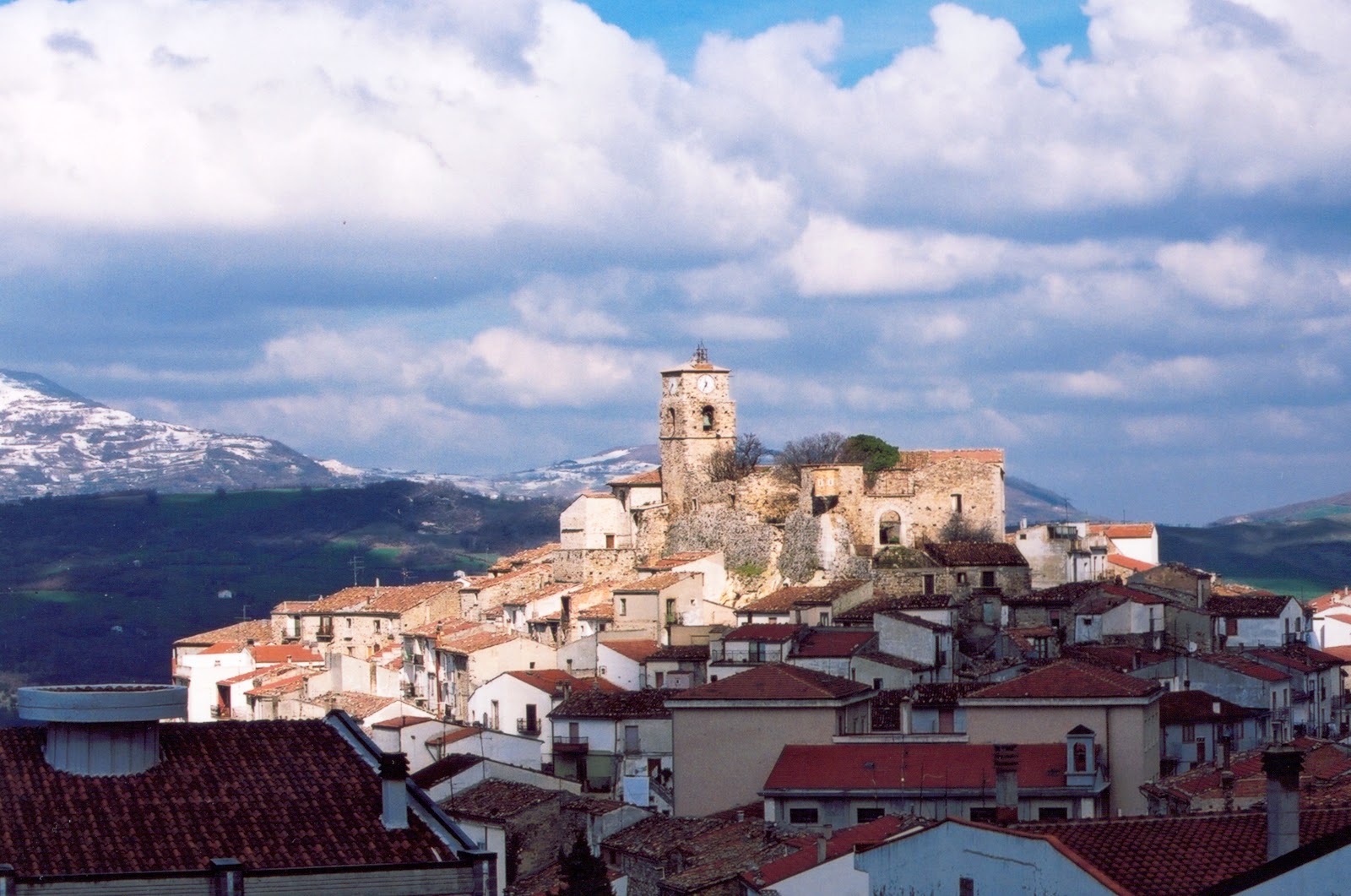 |
| The town of Lupara |
We ended the visit the next morning and Alessio drove us to
Guardiagrelle in Abruzzo where we were to meet another couple of journalists
and continue on with our trip. It was sad seeing him go as we had spent three
lovely days with him.
Next time we continue with our trip to Abruzzo where we meet some winemakers with strange ideas
Tuesday, 14 February 2012
Forward to Friuli
In May 1999 I was invited to Friuli on a press trip. I
hadn’t been to Friuli but I
knew several winemakers from this beautiful region of Italy so I was quite
excited. I landed in Venice and met the rest of the group, which for a change
contained more women than men, before we hopped on the proverbial mini-bus and
began our journey. It was a short trip, just a couple of hours past some of the
prettiest landscape I had seen in Italy. In the distance there were snow capped
mountains and in the foreground green fields and vineyards. It felt crisp and
fresh as we made our way north-west to close to Udine.
 Our next visit didn’t have anything to do with wine although
we did go to a winery. This time we were going to a balsameria. Traditional balsamic can only be called
traditional balsamic if it comes from a small zone around Modena in Emilia
Romagna. There are only 46 makers of ‘balsamico tradizionale’
left and the product is extremely good although extremely expensive. There are
however, many makers of balsamic vinegars around Italy and they produce an aged
vinegar but quite often it is coloured with caramel and artificially aged and
thickened. Azienda Midolini make a
traditional balsamic but can’t call it traditional balsamic because of their
location in Friuli.
Our next visit didn’t have anything to do with wine although
we did go to a winery. This time we were going to a balsameria. Traditional balsamic can only be called
traditional balsamic if it comes from a small zone around Modena in Emilia
Romagna. There are only 46 makers of ‘balsamico tradizionale’
left and the product is extremely good although extremely expensive. There are
however, many makers of balsamic vinegars around Italy and they produce an aged
vinegar but quite often it is coloured with caramel and artificially aged and
thickened. Azienda Midolini make a
traditional balsamic but can’t call it traditional balsamic because of their
location in Friuli.

www.italiantraveller.com
 |
| Fantinel Vineyards at Spilimbergo |
We travelled to the Hotel Weiner located in San Giovanne al
Natisone, a picturesque part of Friuli – it was a pity the hotel wasn’t as picturesque.
It was right next to a railway line and at the time the war was a war going on
in Bosnia. The freight trains loaded with equipment used to go past every night,
I don’t know why as Italy wasn’t involved with the war. All you would hear was
the heavy loads shifting from side to side and the squealing of the brakes
which seemed to stop and start. The hotel was as basic as it could be, iron
beds and blankets, the sort of thing you would stay in if you were a commercial
traveller in some backward eastern-bloc country. The female owner was very
stern and very demanding. She took our passports when we checked in and
wouldn’t give them back until we left.
At that stage Friuli
was without the infrastructure for tourism and many towns didn’t have a hotel
let alone a good one. That changed within a very short time and I have since
been back and stayed at some lovely hotels that have been converted from large
houses.
I had met some of my companions on earlier trips but there
was also a new journalist joining us on the trip, one that would prove to haunt
me a little later that year.
 |
| Belltower at Ca Ronesca |
We visited several wineries over the next two days: Azienda
Borgo Conventi in Farra d’Isonzo , Azienda Fantinel in Dolegna
del Collio, Azienda Ca’ Ronesca,
Azienda Venica e Venica also in
Dologna (and where we first experienced Prosciutto di San Daniele and Fricco
made from Montasio cheese). At one stage we crossed the border to Slovenia to
meet Renato Keber in Cormons. Our last call before
we left the Hotel Weiner was Russiz
Superiore in Capriva del Friuli
which for some reason, had a tunnel all the way from the vineyard to the house.
I can’t remember why but it was a long, long tunnel. At Russiz Superiore, the owner, Marco Felluga,
had organised for a local chef to come in and cook a meal for us. Apparently
our visit was so special that several wineries had done the same thing. The
chef prepared a wonderful meal of pasta then guanciale (pigs cheeks) slow
roasted with a selection of vegetables and a crostata of forest fruits. It was fantastic,
we all left complimenting the chef and thanking Marco, who sadly has sinced
passed away.
The next day we had some free time so we travelled to Aquilea, an ancient Roman city
that sits on the edge of the lagoons. At one time a thriving port, today it is
landlocked with many of the canals empty and the sea wall running across land but was at one time the edge of the sea. It
was a starting point for many nationalities including Celts, Greeks, Jews and
Syrians who helped establish a thriving commercial city. One of the most
interesting things in the whole of Aquilea is the floor of the cathedral which
was completed in the 11th century. The floor is covered in beautiful
mosaics, most of them protected by walkways if my memory serves me
correctly. Some of them are complete
while others have parts missing, whether stolen or just lost. These are
completed with big gaps covered with cement but the whole thing when it was
first built must have been stupendous.
 |
| A statue in the garden of Ca Bolani |
We left Aquilea at lunch time to visit a winery with the
delightful name Ca Vescovo
– the Bishops House. We followed this by a visit to Molin Di Ponte – the mill
of the bridge, owned by Ca Bolani. The
Bolani family were very wealthy in Roman times with Count Domenico, the Procurator of the Venetian Republic in Friuli.
This whole area had a very strong connection with ancient Rome and Julius
Caesar kept several battalions of Roman soldiers here. It was regarded as the
Rome of the north and a statue of Caesar still stands in the piazza of Cividale, a major town in the
area.
We headed to a most unusual winery next, that of Walter
Filiputti. A barbecue and evening of entertainment had been planned for us and
the welcome we received was very effusive. The winery and vineyards were in the
grounds of the Abbazia di Rosazza. The abbey is owned by the archdiocese of
Udine and the vineyards, well I’m not too sure. Walter was a guy who could sell
snow to eskimos and we weren’t quite sure what he said was truthful – there
would be a grain of truth and then a lot of BS.
Surrounding the abbey, which was high on a hill, were
thousands of rose plants, every type of rose in every hue, they were
spectacular. We arrived when they had just come into bloom and the smell of the
flowers was intoxicating and the bees death defying!
Walter told us that he had recently resurrected a grape from
extinction. The red pignolo
grape makes a lovely smooth wine that is quite complex in its structure. He said
it had been found in a vineyard longing to one of their contract growers and he
had rescued it. It had since been grafted onto a number of vines and now they
were going to make a commercial amount of wine from it – it was the next big
thing. Unfortunately for Walter I have since heard several stories similar to
this with different people in the role of the hero.
The entertainment at the barbecue was wonderful, several
friends of Walters turned up, one of them with a guitar and we ate and danced
till late before we were taken back to our beds at the agriturismo where we
were staying. By this stage we had split into two group with one half staying
at the agriturismo of Zamo &
Zamo and the other at the agriturismo of Livio Felluga. (Walter has since
left the wine industry)
The next morning we were on the road again with plans to see
several wineries, there were only two days left and we had reached halfway. The
first was Ronco delle Betulle where we met a nice woman who didn’t export her
wines so basically she was of little interest to us. The next stop however
proved to be very interesting especially for the men!
 |
| Castello Di Spessa |
Castello
di Spessa is a privately owned resort but 15 years ago they were still in
the throes of organising it. The castle itself is large and quite beautiful,
surrounded by wonderful gardens. We were met by a beautiful young lady called Patrizia,
who we thought was married to the owner. Patrizia had on a simple white linen
dress which is some light seemed to turn translucent so that her underwear
could be seen. She had a beautiful figure as everybody could see and she had
the males in the group lusting after her.
She showed us around the castle telling us what a wonderful
time she had had redecorating the place, she had personally chosen every roll
of Laura Ashley paper. She had done Laura Ashley no favours as she had chosen
so many designs above and below the dado rails that it looked like some horrid
psychedelic dream gone wrong. Thousands of tiny blossoms covered the walls in
pale pinks and reds clashing with brown paintwork that looked as if it had come
from a discount sale of end of colours. The only thing I could equate this to
would be someone being violently ill.
Castello di Spessa does not have a winery on-site however
they do have a property down the road a way called La Boatina. Patrizia
was gracious in showing us ‘her’ winery.
We later discovered that the owner was going through a nasty
divorce and Patrizia had met him at a party in Rome. He had taken a fancy to
her (I wonder why?)and let her loose on the castle. She had become very
proprietorial about the castle using ‘I’ a lot. However, the relationship
wasn’t too last and Patrizia was soon back on the party circuit looking for
someone new.
We also were soon back on the road, our next stop the winery
of Girolamo
Dorigo. This eccentric winemaker had a gruff manner and hated being
questioned. However, there wasn’t much that he didn’t know about grapes and
winemaking. We got a lesson that afternoon about density that was going against
the grain on everything we thought we knew but Girolamo was before his time. He
told us about things that are now common practice. No wonder he has been so
successful in Italy.
 Our next visit didn’t have anything to do with wine although
we did go to a winery. This time we were going to a balsameria. Traditional balsamic can only be called
traditional balsamic if it comes from a small zone around Modena in Emilia
Romagna. There are only 46 makers of ‘balsamico tradizionale’
left and the product is extremely good although extremely expensive. There are
however, many makers of balsamic vinegars around Italy and they produce an aged
vinegar but quite often it is coloured with caramel and artificially aged and
thickened. Azienda Midolini make a
traditional balsamic but can’t call it traditional balsamic because of their
location in Friuli.
Our next visit didn’t have anything to do with wine although
we did go to a winery. This time we were going to a balsameria. Traditional balsamic can only be called
traditional balsamic if it comes from a small zone around Modena in Emilia
Romagna. There are only 46 makers of ‘balsamico tradizionale’
left and the product is extremely good although extremely expensive. There are
however, many makers of balsamic vinegars around Italy and they produce an aged
vinegar but quite often it is coloured with caramel and artificially aged and
thickened. Azienda Midolini make a
traditional balsamic but can’t call it traditional balsamic because of their
location in Friuli.
A balsameria is a special space, the aroma is unbelievable.
The vinegar sits maturing in casks of different sizes and woods: acacia, chestnut,
juniper, cherry, oak, mulberry and ash. As the balsamic ages it evaporates and when
the vinegar in one barrel evaporates enough the vinegar is poured into the next
smaller barrel – it’s very similar to a solera system but with different sized
barrels. Most of the balsamic tradizionale is aged for about 12 years +.
At Azienda Midolini the balsamic is called Asperum and it is described as a condiment balsamico.
We were given bottles of it to bring home that were 22 years old, the vinegar
inside was as thick as molasses and it was wonderful. Asperum was on sale at
Simon Johnson at the time and sold for $300 for 100 mls.
After we had had the lesson about balsamic vinegar we then
drove into town where we sat ‘al fresco’ for dinner at La
Di Moret, one of the few good hotels in Udine. We hadn’t realised
that the UEFA cup was on that night and at 10.30 the street erupted with a
number of young men blowing horns and riding up and down on Vespas, the more
the merrier it seemed. Udine had won. We were sat right in the middle of all
the excitement because the hotel had got a large screen TV of the event. We
went back to the agriturismo rather late and slept soundly.
 |
| Azienda Roberto Scubla |
Next day we were to visit four wineries: Azienda Roberto Scubla, Azienda Collavini, Azienda Giovanni Dri
and Azienda Le Vigne di Zamo. Roberto Scubla was a shy man and his winery was
beautifully positioned for photography but we didn’t learn much about the
winery. Collavini was great fun. Learning about how they decided to name the
wines was interesting and gave longevity to their dogs – the dogs were named
after grape varieties and then the dog was put on the label of the wine. My
favourite was a little dog called Ribolla. He still features on their Ribolla
Giallo wine today. Giovanni Dri was a surprise, totally modernist in design his
wines were also very interesting. Although, his notes on the wines were very
strange. Our last visit of the day was actually held at the winery where I was
staying at the agriturismo, Azienda Le Vigne Di Zamo.
Owned by two brothers and their wives Zamo e Zamo as they
were commonly known, had also hired a chef for the night. We started off with
pasta the same as two nights ago. We all said how remarkable that the chef had
chosen the same thing. We then had our main meal, surprise, surprise, it was
guanciale again. We then had dessert and we all had a bet that it would be crostata.
What a pity it wasn’t a lotto night because we would have won big time. The
chef turned out to be the same chef who had cooked dinner two nights
previously. You would think he would have checked, journalists didn’t visit the
area every day of the week. The family were mortified but we all thought it was
funny. Our adventure with food didn’t end there, we were to meet another chef
the next day who far, far worse!

We left the agriturismo at nine am the next day to go to the
Consorzio
Colli Orientale in Cividale. We had a presentation from the publicity
officer which our guide translated for us. It was quite handy that two of us
other than the guide spoke Italian as the guide kept making mistakes. She had
been with us all week and we hadn’t noticed her Italian wasn’t as good as it
should be as everyone we had visited managed to speak to us in English.
 |
| From the Devil's Bridge |
 |
| Julius Caesar |
While we were there, we did a little exploring of Cividale.
It is a pretty little town. At one end of the town you enter by way of a
bridge. There is an old tale about the bridge falling down and the devil
offering to fix it. All he asked for was the first live soul to cross the
bridge. He waited and waited but none of the townspeople would cross until a
little dog crossed the bridge. The devil had to take the little dog as the
first live soul and he wasn’t very happy but he kept his word and the bridge
stands today. It is called The Devils Bridge.
 |
| The Apothecary |
 |
| Medieval House |
Another couple of visits during the day and we went back to
the agriturismo to clean up for dinner. This time we were to eat at the
agriturismo of Livio Felluga. Livio had passed away some years previously and
the winery was run by his children. His daughter Ella, who was extremely glamorous,
was our host. We had some antipasto, which was really delicious and then we had
rabbit. Unfortunately the chef, a great big hulking woman, hadn’t cleaned the
rabbit before cooking it and then to add insult to injury she had cut it up
with a meat cleaver. The rabbit smelt terrible from the organs that had been
cooked inside. The meat had tiny slivers of bone all the way through it. We
left it on the plates which was a pity because Ella wanted it to be perfect.
The next morning we made our way to Rome, a six hour drive
and another trip was over. Roll on the next......
www.italiantraveller.com
Subscribe to:
Posts (Atom)